
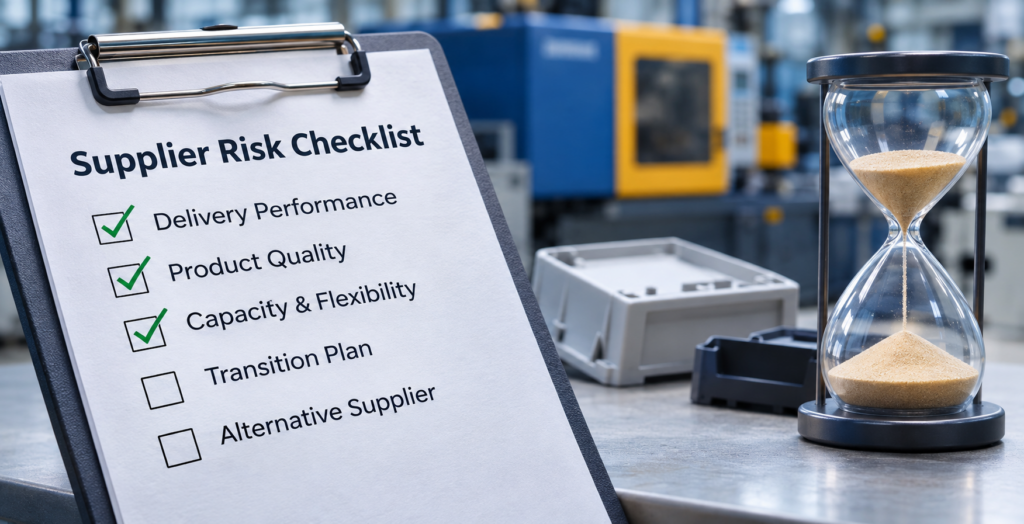
Why proactive supplier planning can protect your production schedule, budget, and brand reputation.
Changing manufacturing suppliers is rarely a decision companies make lightly. Whether driven by quality concerns, rising costs, inconsistent deliveries, or limited production capacity, switching suppliers can feel like a necessary step toward improving operations.
However, many companies wait until problems become unavoidable before exploring alternatives.
What often gets overlooked is that the cost of switching suppliers isn’t just about finding a new manufacturing partner. It’s about the risks that build up while waiting too long to make a change.
1. Production Delays Can Become Expensive
When an existing supplier begins missing deadlines or struggling with capacity, the immediate concern is often getting the next order delivered.
But repeated delays can create larger problems throughout your business.
Missed production schedules may lead to:
- Increased shipping and expedited freight costs
- Interrupted assembly schedules
- Delayed product launches
- Inventory shortages and unfulfilled customer orders
For companies relying on custom injection-molded enclosures or components, transitioning to a new supplier requires planning, evaluation, and production preparation.
Waiting until your current supplier can no longer meet demand leaves little room for a smooth transition.
2. Quality Problems Can Put Your Brand at Risk
It’s common to assume that minor quality inconsistencies can be managed as long as products continue shipping.
Over time, however, inconsistent materials, finishes, or component dimensions can create costly complications.
A plastic enclosure that doesn’t fit properly, a decorative component with inconsistent coloring, or a nameplate that fails to meet appearance expectations can affect how customers perceive your product.
These issues can result in additional inspections, rejected parts, rework, and potentially damaged customer relationships.
Evaluating alternative suppliers before quality becomes a recurring problem gives your team more control over product consistency and brand protection.
3. Rushed Supplier Transitions Can Increase Costs
Switching suppliers involves more than comparing unit prices.
Custom manufacturing projects may require tooling evaluations, material reviews, sample approvals, and production testing.
When a supplier change becomes urgent, companies may face additional expenses from accelerated timelines, temporary inventory purchases, or duplicated production efforts.
Starting the evaluation process earlier allows teams to understand these requirements and make informed decisions without unnecessary pressure.
4. Limited Supplier Flexibility Can Restrict Growth
A supplier that supported your business five years ago may not be equipped to support your needs today.
As production volumes increase or product designs evolve, manufacturing requirements often become more complex.
Companies should periodically evaluate whether their suppliers can accommodate changing forecasts, additional components, new finishing requirements, and inventory needs.
Identifying these limitations early helps prevent supply chain challenges from becoming obstacles to growth.
5. A Proactive Approach Reduces Supply Chain Risk
The best time to evaluate manufacturing alternatives is before your current supplier creates a critical problem.
This doesn’t necessarily mean making an immediate change.
Instead, businesses can reduce risk by reviewing supplier performance, understanding tooling ownership, documenting product requirements, and identifying qualified manufacturing partners.
Having a transition plan creates flexibility when circumstances change.
How PacTec Helps
At PacTec, we understand that changing manufacturing suppliers involves important decisions about cost, quality, and production continuity.
With more than 30 years of injection molding experience, our team supports customers through design evaluations, material selection, tooling considerations, manufacturing, and inventory planning.
Our collaborative approach helps businesses evaluate their options and develop practical production solutions aligned with their requirements.
Don’t wait for a supplier problem to become a production emergency. Planning ahead can help protect your products, your customers, and your bottom line.