
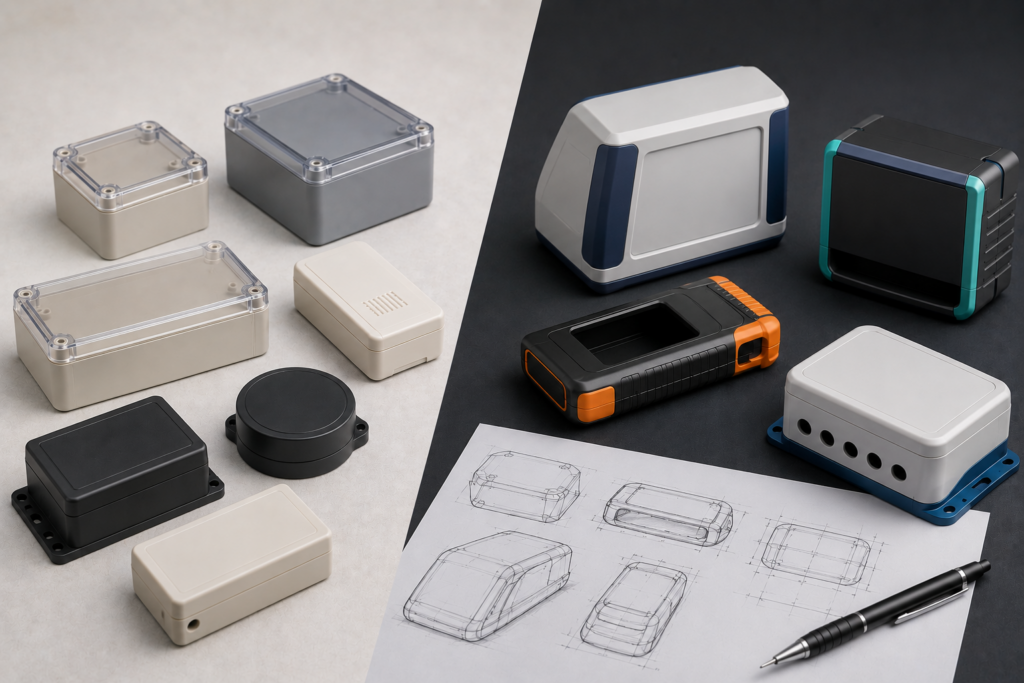
Custom vs Standard: How to Know Which Is Right for Your Product
Many teams default to one of two extremes when launching a new product. Either they assume fully custom is the only professional option, or they try to make a standard off-the-shelf enclosure work no matter what.
It is common to assume this is simply a budget decision. In reality, choosing between custom and standard injection molded components has long-term implications for cost, speed to market, brand perception, and operational risk.
If you are evaluating options for your next enclosure, nameplate, or functional component, here is how to think through the decision clearly.
What “Standard” Really Means
A standard enclosure or component is pre-designed and tooled. It already exists. You are selecting from fixed shapes, sizes, and features.
This option often appeals to teams who:
- Need to move quickly
- Have limited upfront capital
- Are validating early market demand
- Want to avoid tooling investment
Because tooling already exists, you avoid the initial mold cost and shorten development timelines. For early-stage products or lower-volume applications, this can make sense.
However, what often gets overlooked is the compromise. You may need to redesign your internal components to fit the enclosure instead of designing the enclosure around your product. That can create constraints in PCB layout, battery placement, airflow, or user interface design.
Over time, these compromises can affect usability, aesthetics, and even performance.
What “Custom” Actually Delivers
Custom injection molding means the enclosure or component is designed specifically for your product. The tooling is built around your geometry, performance needs, and brand intent.
At PacTec, this typically includes collaborative design support, material selection, and design for manufacturing guidance to ensure the part is production-ready .
Custom solutions are often the right fit when:
- Your product has unique size or interface requirements
- Branding and visual differentiation matter
- You expect medium to high production volumes
- You want long-term cost optimization
It is important to understand that custom does not automatically mean expensive in the long run. While tooling requires upfront investment, per-part pricing becomes very competitive at volume. Injection molding is particularly cost-effective for medium to large production runs due to repeatability and efficiency .
In our experience, teams that plan for scale early avoid costly redesigns later.
5 Practical Questions to Guide Your Decision
Instead of asking, “Which is cheaper?” ask these:
1. How long will this product be in the market?
If this is a short lifecycle product or proof of concept, standard may reduce risk.
If this is a core product expected to run for years, custom tooling often pays for itself.
2. What happens if demand grows faster than expected?
It is common to assume you can switch to custom later. Technically, you can. But redesigning mid-cycle can delay production, require new certifications, and disrupt supply chains.
Planning for scalability early reduces that risk.
3. Does enclosure design impact your brand?
In industries like medical devices, automotive aftermarket, electronics, and appliances, enclosure quality signals product quality. PacTec supports customers across these markets with molded enclosures, branding elements, and functional components .
If your housing looks generic, customers may assume the product is generic.
4. Are you designing around constraints or around intent?
Standard parts force adaptation. Custom parts preserve your original design intent while optimizing for manufacturability.
What often gets overlooked is how much engineering time gets spent “making it fit.” That internal cost rarely shows up in the initial quote comparison.
5. What is your true cost of delay?
If getting to market quickly is critical, a standard option might bridge the gap. But if redesigning later delays expansion, customization, or feature upgrades, that delay has a cost too.
When a Hybrid Approach Makes Sense
This is not always an either-or decision.
Some teams launch with limited customization, then evolve toward a fully custom enclosure once demand stabilizes. Others use custom enclosures but standardize internal components to control cost.
The right choice depends on your production volume, regulatory environment, and growth expectations.
An experienced injection molding partner can help evaluate tooling strategies, material options, and finishing methods while keeping your budget and timeline in mind .
Why This Decision Matters More Than It Seems
Choosing between custom and standard is not just about plastic. It affects:
- Brand perception
- Manufacturing efficiency
- Inventory management
- Long-term unit cost
- Ability to adapt to future product updates
In our experience, the teams who step back and evaluate long-term strategy, not just upfront cost, make stronger decisions.
If you are unsure which direction fits your product, the right next step is not necessarily requesting a quote. It is having a practical conversation about volume expectations, growth plans, and design priorities.
Custom and standard both have a place. The key is choosing intentionally.