
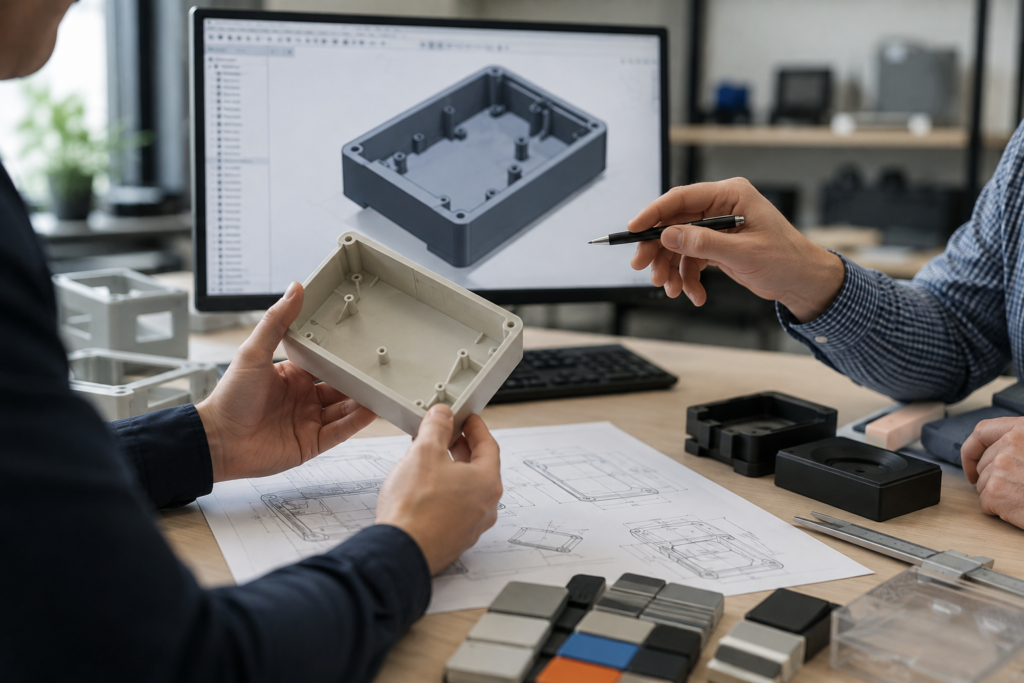
A Great Product Design Still Has to Be a Great Product to Manufacture
It’s common to assume that once a product looks right, functions correctly, and works in a prototype, the difficult design work is finished.
But there is another important question:
Can the product be manufactured efficiently, consistently, and at the volume you need?
That is the basic idea behind design for manufacturability, often called DFM or design for manufacturing.
In plain English, designing for manufacturability means looking at a product through a manufacturing lens before committing to production. The goal is not to change what makes the product valuable. It is to make sure the design can become a real, repeatable product without creating avoidable cost, complexity, or delays.
For injection-molded products, that conversation is especially valuable before tooling is finalized.
DFM Is More Than Asking, “Can We Mold This?”
A design may technically be possible to manufacture while still being unnecessarily difficult or expensive to produce.
What often gets overlooked is how individual design decisions interact with tooling, materials, finishing, assembly, and production.
At PacTec, the design for manufacturing process includes evaluating whether a part can be produced through injection molding while also considering mating components, finishing choices, and assembly processes. The objective is to maintain the intended aesthetics while developing a production-friendly solution.
That distinction matters.
The better question is not simply, “Can this be made?”
It is, “What is the practical way to make this product while preserving what matters about the design?”
1. Think About Manufacturing Earlier Than You Think You Need To
Many teams default to developing a design internally and bringing in a manufacturer once they believe it is nearly complete.
That can limit your options.
A manufacturing partner may identify considerations that were not obvious during the initial design process. Those could involve the molding approach, material selection, tooling, finishing, assembly, or how different components interact.
The earlier those conversations happen, the easier it can be to evaluate alternatives before significant decisions are locked in.
PacTec’s consultative development process, for example, involves engineering throughout concept development, design, material selection, and prototyping, with an emphasis on preserving design intent while considering cost and manufacturability.
2. Look at the Entire Product, Not Just the Molded Part
DFM should not happen in isolation.
An enclosure might eventually need to accommodate internal electronics. A molded component may require a decorative finish. Multiple parts might need to snap together or be assembled using hardware, adhesives, heat staking, or ultrasonic welding.
Each downstream requirement can influence earlier design decisions.
This is why a useful manufacturability review considers the product as a system. PacTec evaluates not only molded-part designs but also mating components, finishing options, and assembly processes during product development.
Thinking through those relationships early can help prevent a situation where solving one manufacturing problem creates another somewhere else.
3. Avoid Over-Engineering the Product
More complexity does not automatically create a better product.
In our experience, unnecessary complexity can introduce additional manufacturing considerations without adding meaningful value for the end user.
The same principle applies to materials. The “best” material is not necessarily the most expensive or highest-performing option available. The right choice depends on what the product actually needs to withstand, including factors such as ultraviolet exposure, temperature, impact, stress, movement, appearance, and industry-specific requirements. PacTec works with customers to select materials and finishes based on those end-use needs.
Good DFM is about finding the appropriate level of engineering for the application.
4. Consider Tooling and Production Volume Together
Tooling should support how the product will actually be manufactured.
Production requirements can vary significantly from one project to another, so tooling decisions should reflect anticipated output as well as product requirements.
PacTec supports tooling approaches ranging from lower-cost insert tooling to multi-cavity tooling and uses mold-flow analysis to help evaluate designs and identify opportunities to improve manufacturing efficiency, cost, and part quality while maintaining functional and aesthetic requirements.
This is another reason manufacturability should be discussed before tooling decisions become difficult or expensive to change.
5. Remember That DFM Is About Business Outcomes, Too
Design for manufacturability can sound like an engineering exercise. For buyers and product teams, however, the consequences are much broader.
A production-friendly design can affect project cost, development time, production consistency, assembly requirements, and ultimately speed to market.
PacTec’s Powerteq case study provides a useful example. Powerteq had internal designs that were not production friendly and needed manufacturing expertise to move concepts toward production. PacTec provided industrial design, design-for-manufacturing, and prototyping support, which the case study credits with reducing internal design and engineering costs and accelerating speed to market.
That is the practical value of DFM: addressing manufacturing realities while there is still time to make productive design decisions.
When Should You Start Thinking About Manufacturability?
Ideally, before the design is considered completely finished and certainly before production tooling is finalized.
You do not need to have every answer before talking with a manufacturing partner. In fact, involving manufacturing expertise while there is still room to evaluate materials, features, finishes, assembly methods, and tooling approaches can make that conversation more useful.
At PacTec, customers work directly with U.S.-based engineers on 3D modeling and CAD file evaluation as part of the design-for-manufacturing process. The broader development approach can also include industrial design, mechanical design, material selection, prototyping, tooling, molding, finishing, assembly, and production.
The goal is straightforward: preserve the intent behind your product while making sure the design is ready for the realities of manufacturing.
That is what designing for manufacturability really means.