
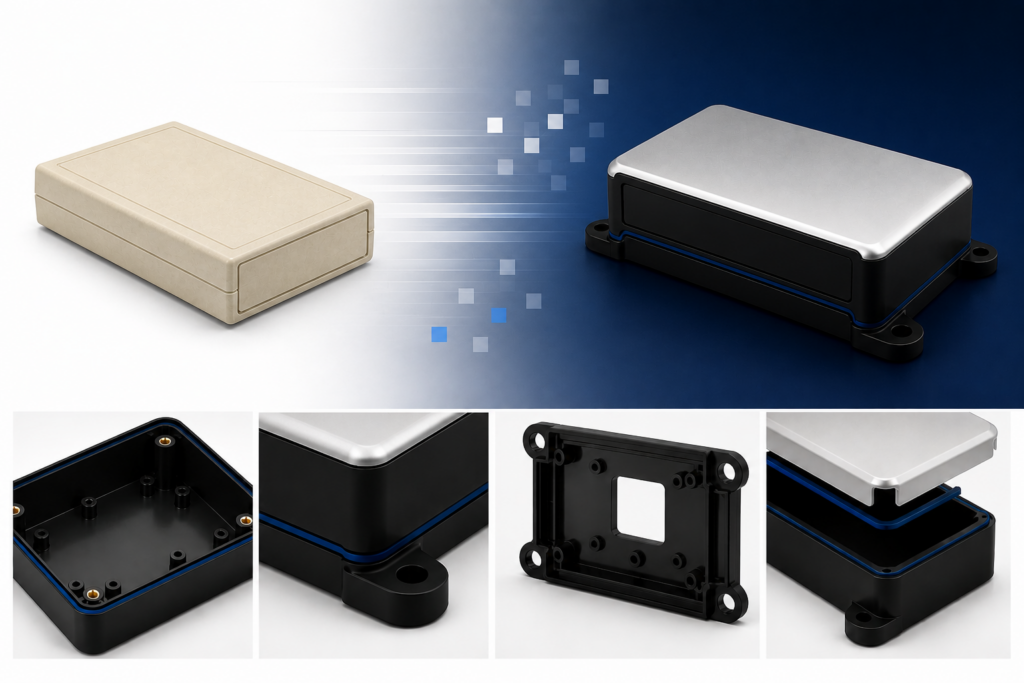
Many Teams Default to Off-the-Shelf Housings
When launching a new product, speed matters. It’s common to assume that selecting an off-the-shelf plastic enclosure is the safest and most cost-effective option.
And early on, that may be true.
Standard enclosures help avoid upfront tooling costs. They reduce development time. They feel low risk.
But what often gets overlooked is how quickly those early savings can turn into long-term limitations.
In our experience, there is a tipping point where off-the-shelf parts stop making financial and strategic sense.
The challenge is recognizing that moment before it impacts margins, brand perception, or scalability.
The Hidden Tradeoffs of “Good Enough”
Off-the-shelf enclosures are designed to work for general applications. That means they are built to accommodate a wide range of use cases, not your specific product.
This often leads to compromises:
- Extra internal space you don’t need
- Secondary machining to create custom openings
- Cosmetic elements that don’t align with your brand
- Mounting features that almost fit
At first, these seem manageable.
But as volumes grow, those small inefficiencies compound.
Secondary CNC modifications add labor cost. Extra assembly steps slow production. Workarounds increase variability. Larger-than-necessary housings increase material cost and shipping weight.
It’s common to assume these are minor adjustments. In reality, they can quietly erode margins.
Signs You’ve Outgrown Off-the-Shelf Parts
Not every product needs a fully custom enclosure. But there are clear signals that it may be time to reconsider your approach.
1. You’re Modifying Every Unit
If every enclosure requires cutting, drilling, labeling, or repainting, you are already customizing. You’re just doing it inefficiently.
Custom injection molding integrates those features directly into the tool, eliminating repeated secondary work.
2. Your Volumes Are Increasing
Low volumes often justify stock components. But once production reaches consistent medium or high volumes, the math changes.
Tooling becomes an investment rather than an expense. Per-unit costs drop. Labor decreases. Scrap risk declines.
Many teams wait longer than they should to run this comparison.
3. Your Brand Is Growing
Off-the-shelf housings rarely reflect a strong brand identity. They look familiar because competitors may be using the same base product.
What often gets overlooked is how enclosure design influences perceived value. Custom textures, decorative trim, nameplates, and finishing options elevate product presence.
If your product is gaining traction, packaging it in a generic box can limit its perceived quality.
4. You’re Designing Around Constraints
When engineering teams start saying, “We had to move that component because the housing wouldn’t allow it,” that’s a signal.
Your enclosure should support your design. Not the other way around.
Why This Decision Matters
Choosing between stock and custom is not just a cost conversation. It’s a business strategy decision.
In our experience, staying with off-the-shelf parts too long can lead to:
- Higher long-term unit cost
- Increased assembly complexity
- Brand limitations
- Supply chain dependency on third-party stock availability
- Delays when parts are discontinued or changed
On the other hand, moving to a custom injection molded solution allows you to:
- Optimize wall thickness and material usage
- Integrate mounting features and internal supports
- Improve fit and finish
- Align aesthetics with brand positioning
- Control your production timeline
It shifts you from adapting to someone else’s design to owning your own.
Common Concerns About Going Custom
It’s common to assume custom injection molding automatically means high risk, long timelines, and large minimum volumes.
But that’s not always the case.
With the right manufacturing partner, design for manufacturing principles are applied early. That reduces tooling revisions and startup issues. Prototyping and renderings simplify decision-making. Production planning aligns with realistic forecasts.
For over 30 years, PacTec has supported customers in transitioning from off-the-shelf solutions to custom molded enclosures, nameplates, and functional components .
The key is evaluating the full lifecycle cost, not just the upfront tooling number.
A Practical Way to Evaluate Your Situation
If you’re unsure whether it’s time to move away from off-the-shelf components, ask:
- What is our true per-unit cost including modifications and labor?
- How much time does assembly currently require?
- Are we compromising internal design to fit the housing?
- Does our enclosure reflect our brand’s growth?
- What happens if this stock part becomes unavailable?
When you step back and view the enclosure as part of your product strategy, not just a container, the answer often becomes clearer.
When Custom Starts Making Sense
There is no universal volume threshold where custom automatically wins. The tipping point depends on your product complexity, growth rate, and market positioning.
But when you find yourself repeatedly working around the limitations of a stock part, that’s usually the moment to pause.
Custom injection molding is not about making something flashy. It’s about creating a production-friendly, cost-effective, brand-aligned solution designed specifically for your product.
Many teams default to off-the-shelf parts to reduce risk. Ironically, staying there too long can create more of it.
The goal isn’t to move to custom as quickly as possible. It’s to move at the right time, with clarity and confidence.
If you’re approaching that inflection point, it may be worth running the numbers and exploring what ownership of your enclosure design could mean for your next phase of growth.